I worked it on myself first. Then it became a responsibility.
I am a medical doctor, and that is where this story has to begin, because everything on this site comes from one decision: to take all of my medical knowledge, my pursuit of psychology and the human sciences, and an experience I never stopped seeking — and put it all in the service of the ummah. But I did not start with the ummah. I started with myself. The Qur'an as a daily practice, the science as a discipline, the psychology as a mirror: I tested every bit of it on my own heart before I said a word of it to anyone else. It proved to help me — through medical school, through the hospitals, through years of standing in front of rooms full of hearts. And once something has proven to help you, keeping it to yourself stops being modesty. It became a responsibility: to use it to serve my ummah, and to publish it for the same cause.
Every vision is rooted in experience, and mine is rooted in Al-Azhar. As a boy I began my day in the kuttāb. I still remember those blessed hours after Fajr — quiet, sacred, filled with recitation — sitting with my shaykh until it was time to head straight to school. In the summer, from the moment I woke up until Ẓuhr, my time belonged to the Qur'an, to my teacher, to my dīn. Those hours made Islam not something I practised but something woven into me. I never felt alone, because the Qur'an was with me.
Later I noticed something remarkable. Nearly all of my classmates who shared that rhythm excelled — many scoring over 99% in Al-Azhar high school while carrying Arabic and Islamic studies on top of the state curriculum. It was never a burden. It sharpened us. And when I entered medical school the fruit was clearer still: the best among us — academically, intellectually, spiritually — were the ones shaped by that same Qur'anic foundation. Early, immersive Islamic education does not hold children back. It lifts them higher.
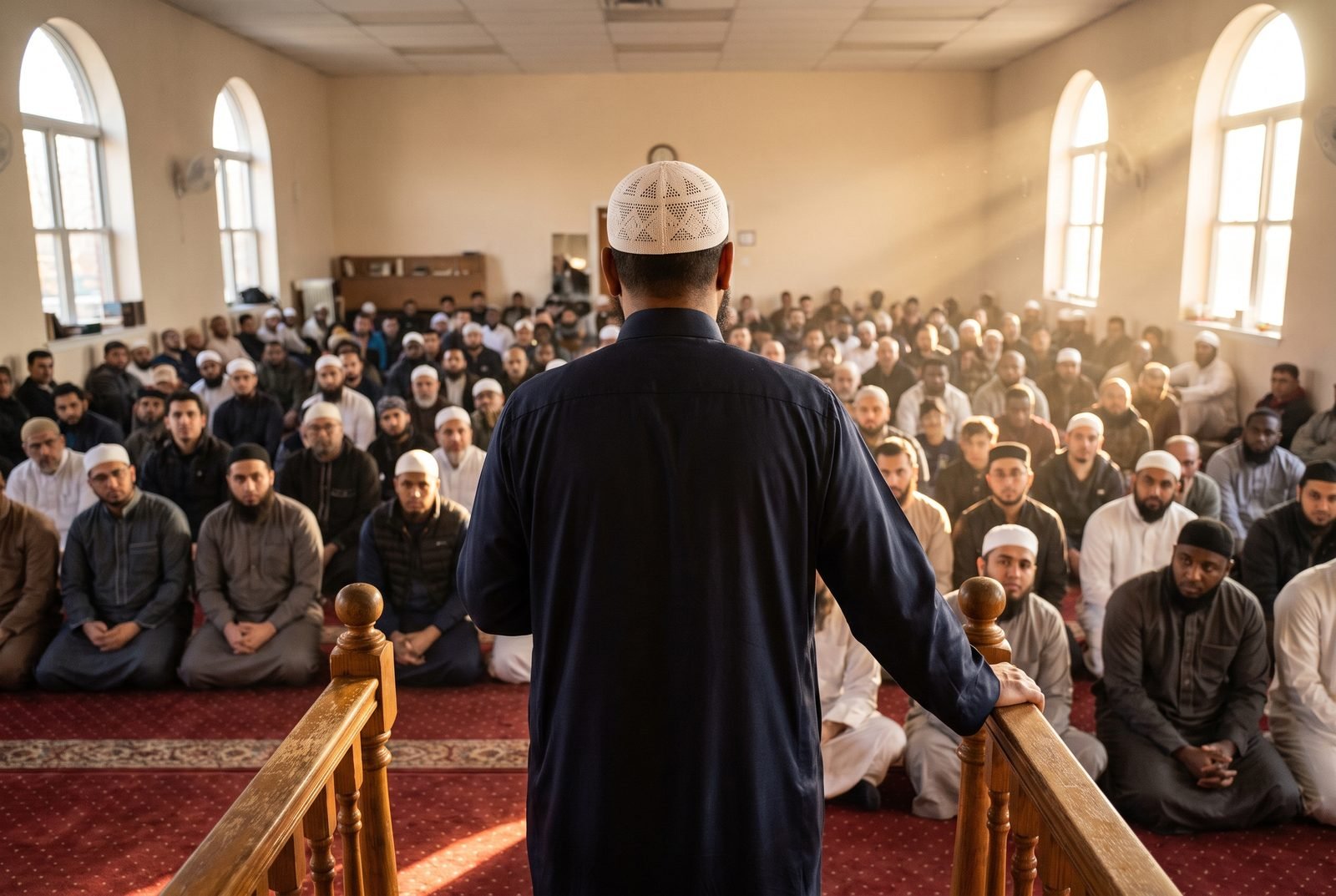
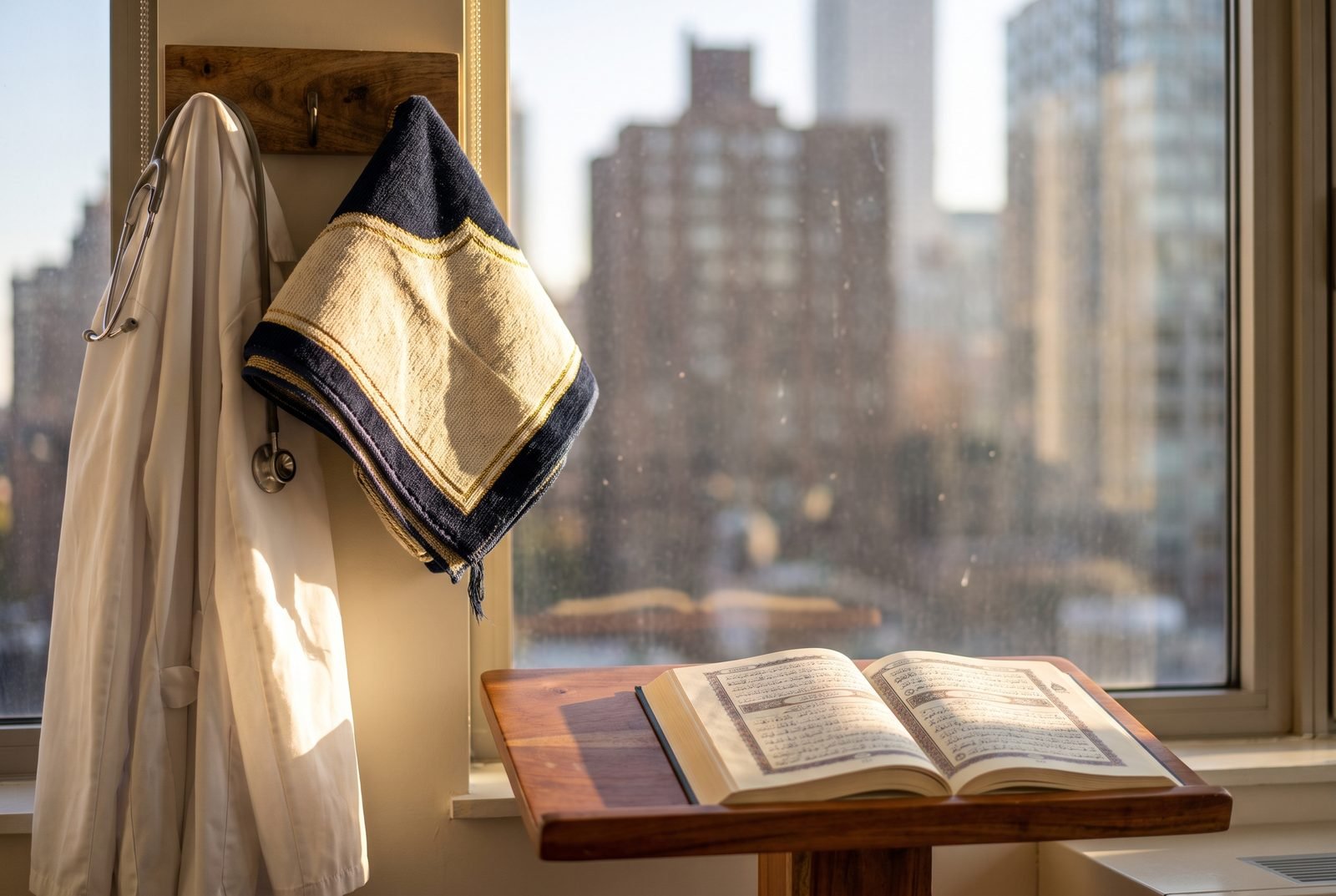
I was twelve the first time I stood on a minbar, and I discovered something that has never left me: a khutbah is not a lecture. It is a room full of hearts, and you are responsible for what they leave with. At Al-Azhar I did two things at once that people kept calling opposites — medicine, with its anatomy and long clinical nights, and the Qur'an, its sciences, its tafsir, its transmission, until I held an ijāzah with a chain that reaches back to the Prophet ﷺ. I never found the contradiction I was warned about. I found one responsibility with two rooms: the ward, where the body is a trust, and the minbar, where the heart is.
Alongside my medical classes I started teaching American students Qur'an and Islamic studies online. At first it was simply a way to support myself and ease the burden on my family. Very quickly it became something much deeper: each session was not about letters and rules, it was about guiding a future. And I saw another truth — brilliant graduates of Islamic universities in Egypt carrying immense knowledge and living with little opportunity, for whom one chance could change everything. Teaching was never a job to me. It is a noble cause. That is where the idea of an academy was planted: to give back to those teachers, to open doors, and to build something none of us could build alone.
Teaching students in the United States taught me that their needs were different. Looking at their difficulties from the outside made them easier to understand — like a case in psychiatry: you step back, you locate the source, you diagnose precisely. Every student became a case that asked for sensitivity, adaptation and care. Teaching is not repeating what you know. It takes real training, deep roots and psychological insight before you can say, “I am ready to teach.” Islamic education today has to combine authenticity with psychological wisdom — without that balance we do not reach hearts and minds. So I kept seeking: psychology, the human sciences, the clinic. Not to decorate the tradition, but to serve it.
In 2017 I moved to New York. The hospitals came first — Mount Sinai's pathology floor, then the trauma bay and the ICU at St. Barnabas in the Bronx — and, in the same years, five as resident scholar at the Islamic Center of Mid-Westchester and two at MAS Queens Center: daily prayers, tarāwīḥ with khatm, nikāḥ and janāzah, counselling at kitchen tables, and a Friday khutbah every week in English. I watched a generation sit through lectures with full minds and untouched hearts, and I watched their parents search for a teacher who would actually listen to their child read.
So I started building. First a program — Speak to Lead — because a young Muslim who can stand up and speak the sīrah clearly is already a leader. Then the software: a companion that tracks a whole Muslim life, a storybook that turns every āyah into a scene a child can step inside, a muṣḥaf that reads aloud and grades your recitation, and the Academy, where a real teacher meets one learner at a time. And the books, because some things only a book can do: The Heart You Bring names the diseases of the heart and shows the door out; the tafsir explains every sūrah in a voice you can read from a minbar and alone at night; Look Again reads the Qur'an on the human interior; Reading El-Naggar audits a lifetime of science-and-Qur'an claims.
All of it comes from one intention, renewed before anything else: to serve Allah by serving His Book, His dīn and the next generation. This work is a trust before it is a business, a responsibility before it is a project — and every student, every family, every community I work with is an amānah. What was learned for my own heart is published for the ummah's, for the same cause. Success in this life and the next is one curriculum, not two, and the next generation deserves to be raised with both.